
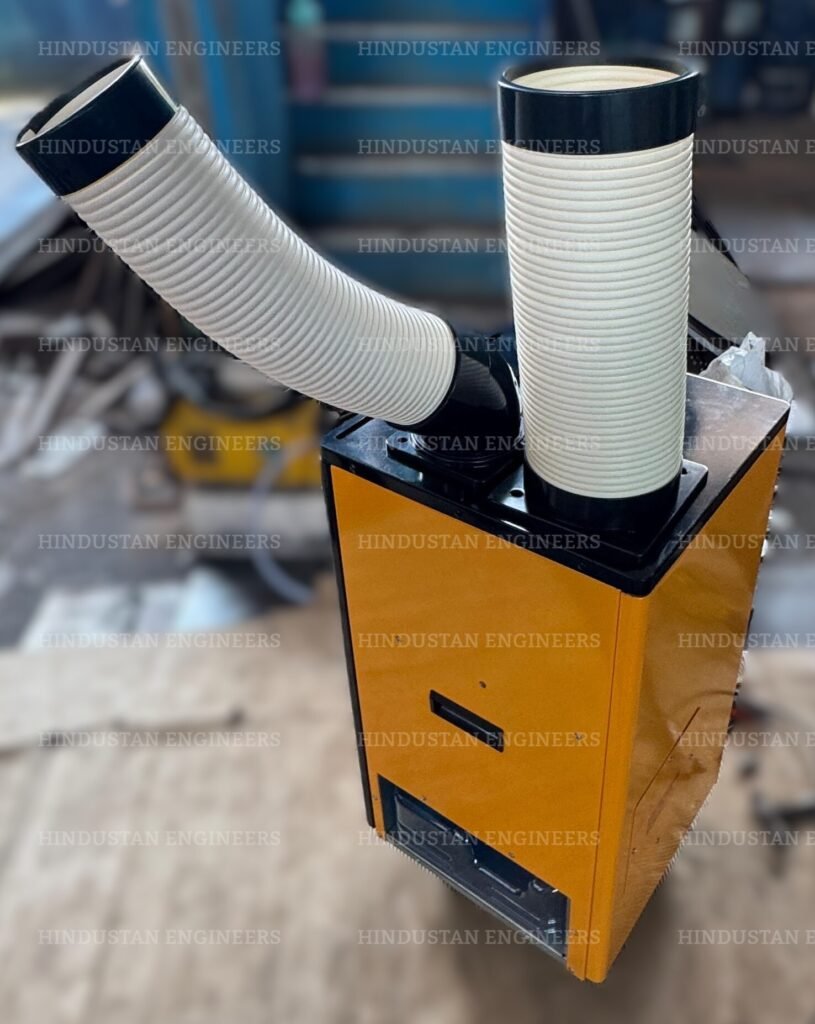
A spot cooling system is a specialized air conditioner designed to cool specific people, machinery, or work zones instead of an entire room. Think of it like a flashlight that shines cold air exactly where you point it, which saves energy in massive spaces like factories, server rooms, and warehouses.
To choose or evaluate a spot cooler, you need to understand its primary technical specifications.
Core Technical Specifications
1. Cooling Capacity
This measures how much heat the unit can remove from a space. It tells you how powerful the machine is.
- Measurement Units: Measured in BTUs per hour (British Thermal Units) or Kilowatts (kW).
- Typical Range: Small portable units start around 10,000 BTU/hr (approx. 2.7 kW). Large industrial models can reach up to 60,000 BTU/hr (approx. 17.5 kW) or more.
- Analogy: If you are trying to cool down a single hot machine, a lower 10,000 BTU unit works. If you are cooling multiple workers in a hot warehouse, you will need a 23,000+ BTU unit.
2. Airflow Rate
This tells you how much cold air the machine blows out every hour to push the heat away.
- Measurement Units: Measured in Cubic Meters per Hour (m³/hr) or Cubic Feet per Minute (CFM).
- Typical Range: Ranges from 400 m³/hr for small systems to over 1,200 m³/hr for industrial systems. Higher airflow helps the cold air reach farther out into open spaces.
3. Electrical Requirements
You must match the spot cooler to your building’s available power outlets.
- Voltage and Amps: Small, portable models run on standard home/office power (115V or 230V, drawing 10 to 15 Amps). Large industrial units require heavy-duty power (460V, three-phase power).
- Power Cord: Most mobile units come with a standard 10-foot power cord built for safety.
4. Condensate Removal (Water Management)
As air conditioners cool the air, they squeeze moisture out of it like a sponge. This water (condensate) must go somewhere.
- Internal Tank: Many units collect water in a built-in tank (typically 5 to 20 liters). The system will automatically shut off when the tank is full so it doesn’t spill.
- Condensate Pump: High-end models have a built-in pump that automatically sends the water through a small hose into a nearby drain, allowing the machine to run 24/7 without stopping.
5. Physical Build and Portability
Because these units are often rolled into tough environments, their physical build matters.
- Mobility: Usually equipped with heavy-duty 360° caster wheels (with brakes) so you can roll them anywhere.
- Ducts/Nozzles: They feature 1 to 3 flexible, rotatable “snout” nozzles that let you aim the cold air exactly where it is needed.
- Housing: Built with tough, 18-gauge sheet metal or powder-coated steel to survive bumps in workshops.