

Polyester Felt (PE) The most common used and cost effective filter felt in modern pulse jet style baghouses. Typical applications range from cement plants to electric furnaces. It has a normal maximum continuous operating temperature is 275°F. Polyester filters offer very good resistance to chemicals, abrasion, and dry heat degradation. This filter is good for dry heat applications and superior to other synthetics with the exception of Nomex (Aramid) and Teflon in this regard. Polyester is not a good choice for moist heat and subject to hydrolytic degradation under certain circumstances. Polyester offers good resistance to most mineral and organic acids except high concentration of nitric, sulfuric, and carbolic acids. It has good resistance to weak alkalis and moderate resistance to strong alkalis at low temperature. Not recommend for high concentration of strong alkalis at high temperatures. Polyester also has good resistance to most oxidizing agents and excellent to most organic solvents. It is not recommended for some phenolic compounds.

Polyester Felt Popular Finishes:
Singed Polyester (SIPE) – The felt is singed on the dust cake side for improved cake release. Most common type of filter media used in modern baghouses. The process involves exposing the surface fibers to an open flame that melts back the loose fiber ends to which dust particles could adhere.
Glazed Polyester (GLPE) – This process involves running the felt through two heated rollers to melt back the loose fiber ends improving the cake release. The process can also compress the felt to smooth the surface, further improving the dust cake release.
SlyTech-01 (ST-01) – Oleophobic -water and oil repellent finish. SlyTech-01 is a complete PTFE bath which provides an excellent cake release finish to each fiber. This finish is cheaper and more durable than a membrane that can be easily scratched.
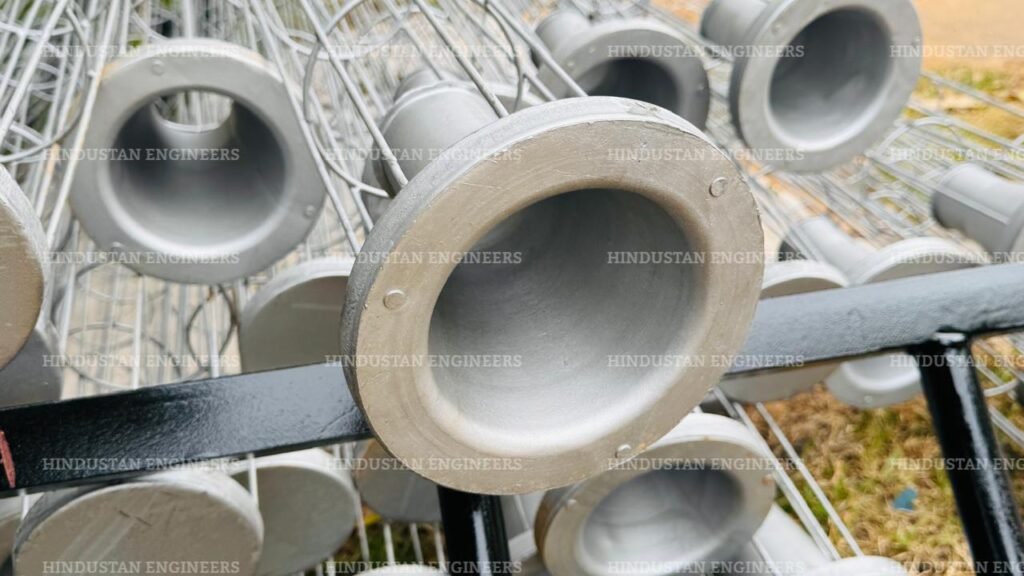
Filter bag cage also named dust collector cage is made of stainless steel or carbon steel with galvanization, silicon coating, epoxy or PVC vinyl coating finish. It is a kind of strong cage which works with filter bag to remove dust efficiently. This cage uses the advanced hot-melt jointing technology. The jointing method of bag bottom, side and collar ring all are hot-melt welded, that can avoid the pinholes from seam filter bag. Its construction consists of vertical and horizontal wire. The horizontal wire can be round, flat or envelop shape which is welded smoothly with vertical wire. So this cage shape can be round, flat, envelop. Besides, Its connection way can be clamp, chuck, claw join, guide plate connection. It is light and easy for installation and maintenance.

Pulse-jet style baghouses are designed to utilize fabric filter bags with internal support structures commonly referred to as cages. Baghouse Filter Cages provide a means of holding the filter bag open during the particulate collection cycle. Cages must be strong to withstand the pressure from the filter bag exerted during the particulate collection cycle.
Additionally, cages must be selected with the proper structure design to conform to the fabric requirements. Gas stream chemistry will determine whether special metals or special coatings will be required to reduce or eliminate corrosion to the cages’ metal surfaces. Cage sizes, both length and diameter, can be crucial to the success or failure of the filter bag.
The strongest filter bag cage for pulse-jet baghouses is known as the “rigid wire” cage. It is designed to provide uniform support to the overall length of the fabric filter, utilizing “stringer” wires that are equally spaced around the circumference of the cage. Each stringer wire is then welded to support rings that are spaced along the length of the cage. The diameter of these rings plus the wire gauge of the stringers determines the overall diameter of the cage. Special cage tops, such as roll band and roll flange styles, are also welded to the stringer wires; thereby developing a strong internal assembly from which to attach the cage and filter bag to the baghouse tubesheet. The cage bottom is either interlocked to a stringer ring or welded to the stringers. Either method is equally sufficient for support.
The number of stringers used in cage construction depends on the applicable requirements and fabric used for the filter bag. 10, 12, and 20 wire stringers are the standards. 10 wire stringers are usually used on heavier weight felts. 12 wire stringers are usually used on lighter to medium weight felts. 20 wire stringers are usually used on fiberglass fabric filters and other media that require maximum support, thereby reducing the excessive flexing of the fabric yarns that usually causes premature bag failure.