
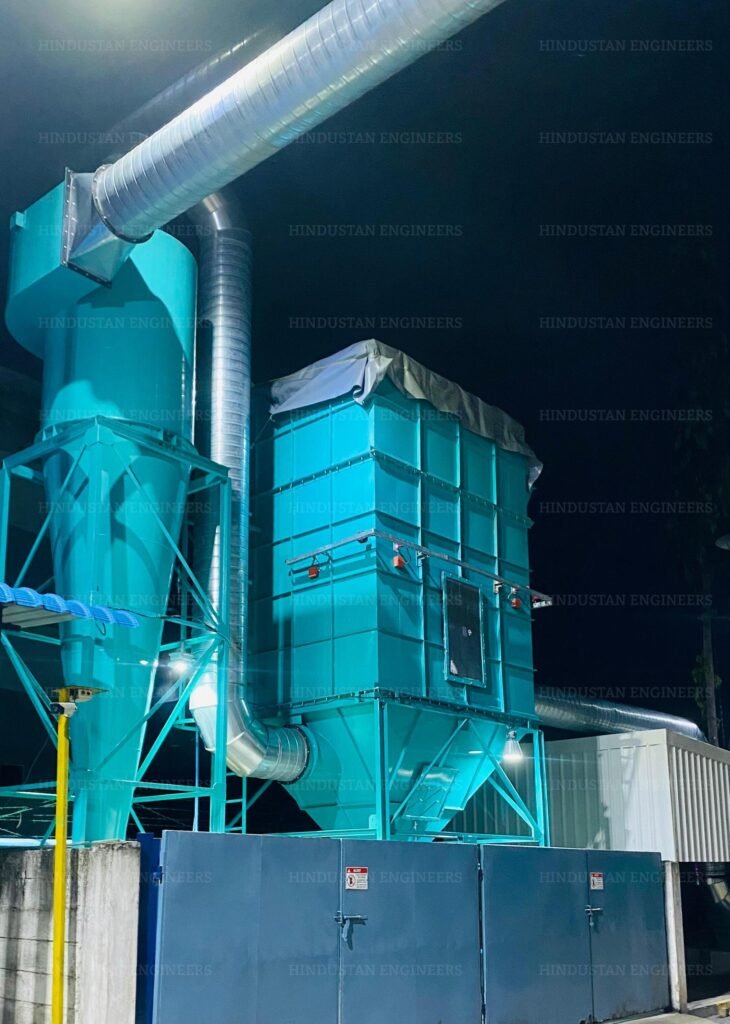
The Modular Baghouse collector comes in two models: the MBT allows walk-on, top access to the bags (clean-air side) of the collector. This configuration is ideal for indoor or tight budget applications. The MBW offers a walk-in clean-air plenum, so bags can be replaced in any kind of outdoor weather.
The Modular Baghouse has a hopper inlet that was designed with the help of computer airflow analysis to provide maximum performance. When dusty air enters the inlet, it hits a deflector plate at the end of the inlet, which causes heavier particles to drop directly into the hopper. This design reduces the amount of dust that comes in contact with the bags, thus reducing bag abrasion and providing reduced pressure drop and longer bag life.
Dumpster Discharge for Heavy Dust Loading
For applications with heavy dust loading, the MB has an easy to use Dumpster Discharge. This option provides either a 1.5 or 2.3 cubic meter / two or three cubic yard self-dumping dumpster that can be hauled away with the use of a forklift. The dumpster comes with a lid that seals the system so that no rotary valve is required. The lid is lifted off of the dumpster via a mechanical lift, which is included with the package.
Two Breakthrough Filter Options for Your Modular Baghouse
Traditional 540 g/m2 / 16 oz/yd2 polyester bags are produced via a needling process that creates larger pores where dust can embed into the fabric, inhibiting cleaning and reducing bag life. Dura-Life bags are engineered with a unique hydroentanglement process that uses water jets to blend the fibres. This process creates a felt with smaller pores which keeps more dust on the surface of the filter resulting in better pulse cleaning and longer bags life.
Here are some key components and features of a filter bag dust collector system:
Filter Bags: The primary component of a filter bag dust collector system is the filter bags themselves. These bags are made of various materials such as polyester, aramid, PTFE, or other specialized fabrics that provide high filtration efficiency and durability. The filter bags capture dust particles as contaminated air passes through them, allowing clean air to exit the system.
Baghouse: The filter bags are housed in a structure known as a baghouse, which is typically a large enclosed chamber designed to hold the filter bags in place and provide efficient filtration of dust-laden air. The baghouse may consist of multiple compartments or sections to accommodate the filter bags and optimize airflow.
Ventilation System: A fan or blower is used to create airflow that moves dust-laden air through the filter bags inside the baghouse. The fan creates a negative pressure within the system, pulling air and dust particles into the collector for filtration. The filtered air is then discharged back into the environment or recirculated indoors.
Cleaning Mechanism: Over time, dust accumulates on the surface of the filter bags, reducing their filtration efficiency. To maintain optimal performance, filter bag dust collector systems often incorporate a cleaning mechanism to dislodge and remove the accumulated dust. Common cleaning methods include pulse-jet cleaning, reverse air cleaning, shaker cleaning, and mechanical shaking mechanisms.
Control System: Modern filter bag dust collector systems are equipped with control systems that monitor and regulate the operation of the collector. These systems can control cleaning cycles, adjust fan speed, and provide alerts for maintenance and troubleshooting.